
The Serpent Priest
“Knowledge of ourselves begins and ends with knowledge of the stars. Our knowledge of ourselves and of our stars only persists as long as we do.”

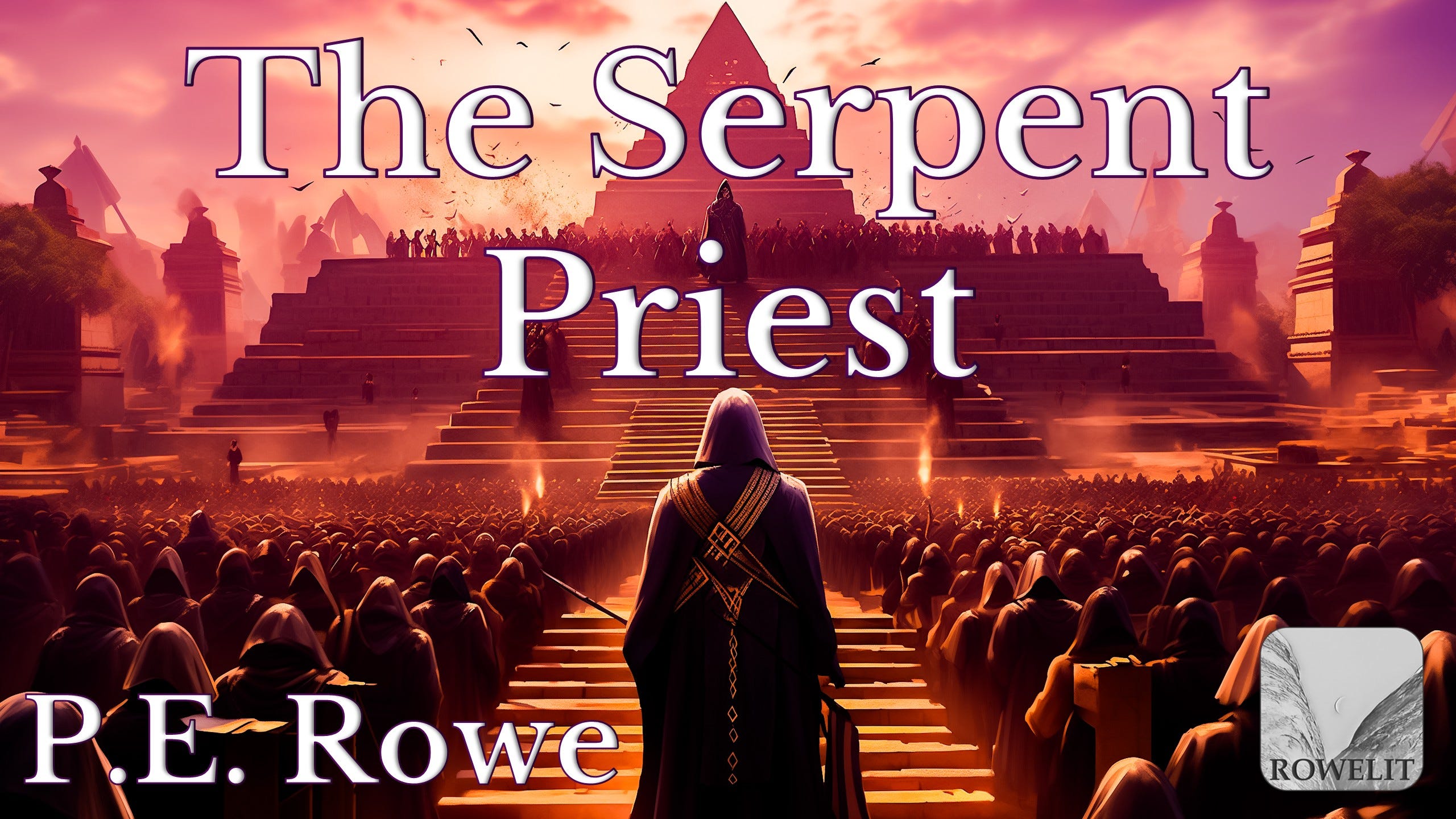
The Serpent Priest went back into the hills; with him were the Child of the Sun and the Daughter of the Moon. Their time had almost come, yet the Serpent Priest broke with all tradition and written wisdom of the Faith. There would be no public union in the City of Light. If the people were to survive, the cycle would need to be broken.
They departed the City of Light on foot, as was their way, but they walked with great urgency into the countryside, not once stopping at the towns and cities along the way, even bypassing the temples where the clergy had always hosted them on their pilgrimage to the City of Light.
The timing was all wrong. Never before had a priest of the Serpent’s Order broken from the cycle, not in the three thousand years of this cycle, nor of the oral accounts of the cycles that came before. The Keepers of the Flame would never allow for a madman to become Serpent Priest. But it seemed to the Emperor of Light that in this case they had.
Surely, over thousands of years it was bound to happen once. That it was during his reign meant that he had one duty he was born for. This was providential, and he would not allow his reign to be the one that broke the Chain of the Ages. The Emperor of Light had many obligations, but securing the knowledge passed down through the times of flood and fire was the highest of all duties. A madman for a Serpent Priest could spoil it all. One mad steward of the ancient wisdom.
So the Emperor of Light went out on foot from the City of Light, into the countryside and far into the hills to speak with the Serpent Priest.
In that age, of course there were technologies of communication that would have been wonders in other times. Yet the Serpent Priest and his Vicars abided by the timeless ways in the performance of their duties. No missives were sent, only messengers with the high priest’s word. No one was to know the word but his heralds and the recipients.
When he returned to the entrance to the underworld, he, the Child of the Sun, and the Daughter of the Moon knelt and meditated on the weight of their duties, and the Serpent Priest dispatched messengers to the Vicars of the realm.
For the Emperor of Light, it was impossible to know the words the Serpent Priest would share with his Vicars. Yet messengers had only been sent out from the temple mouth so many times before, with only so many messages conveyed. It seemed to confirm the Emperor’s worst fear—that the Serpent Priest had gone mad and was summoning the Vicars to the underworld in the middle of the cycle, and with that word from the Serpent Priest, the Vicars would be calling the Blessed to their fate.
When the Emperor of Light received confirmation that the Serpent Priest had sent out his heralds, he quickened the pace of his procession. It was for tradition alone that he sought out the Serpent Priest on foot, but as the Serpent Priest himself seemed to be engaged in the destruction of those very traditions, the Emperor’s slow approach was only serving to aid the Serpent Priest’s aims. Still, the people had seen the Emperor and his entourage in the countryside on his way to the hills. To do anything but continue the procession would incite a panic among the people. Order had to be maintained.
Thus, by the time the Emperor of Light arrived at the temple mouth, the Serpent Priest’s heralds had already spread far into the countryside.
The Emperor of Light was met with all presiding honors. He and the Serpent Priest sat for a ceremonial tea at the temple mouth as dictated by tradition. The Emperor examined the eyes of the high priest, finding that there was no madness in them. Nor were his words erratic or scattered, so to the Emperor’s surprise, the Serpent Priest appeared sound of mind.
When the ceremonial greeting was concluded, the Serpent Priest escorted the Emperor of Light through the temple mouth, down into the opening to the underworld. Here, only flame lit the way, and yet, when his eyes adjusted, the Emperor of Light could see the magnificence of the vast amphitheater concealed at the bottom of the spiral temple stairs. Few but the Blessed of generations passed, as well as the Vicars of the order, had ever beheld even the opening to the city of the underworld. Here, in the vestibule, the Serpent Priest lit a candle between himself and the Emperor of Light, and he directed the Emperor to sit with him atop the medallion that encompassed the center of the amphitheater’s grand floor.
The Emperor asked the Serpent Priest what his intentions were in sending out his heralds. Survival, was the holy man’s answer.
The Serpent Priest told the Emperor of Light what he believed to be true: Knowledge of ourselves begins and ends with knowledge of the stars. Our knowledge of ourselves and of our stars only persists as long as we do. The Faith contends that we may persist here in the underworld through the times of flood and fire. So too may we endure here now that the stars themselves seek to remove us from their domain.
These words were familiar to the Emperor of Light. They were the words of the emissary of the Empress of Shadow. Her house had been visited by a witch from the far reaches of her empire with a story of peoples in the stars who had preceded even the oldest known cycles. They too had spread throughout the galaxy and among distant stars, and they had vanished from the cosmos by the will of a race of higher beings. The Empress’s emissary conveyed that this witch had shared warnings of these higher beings returning again to cleanse the galaxy of our kind, for it was not in our nature to keep to our place. Thus it has been our destiny to forget the worlds that have come before our own.
This story is madness, the Emperor of Light declared. Madness, or else the trick of our oldest rival. It is done to diminish the Faith and demoralize the faithful, for if the Blessed descend to live out their lives in darkness and neither floods nor fires consume the lands above, when they emerge to find their most precious years wasted, their farmlands tilled by others, their homes happily inhabited by thriving tribes, they will denounce their duties before the cycle’s end, and the Empire of Light will die before the floods and fires even make their mark upon the land once more.
To this the Serpent Priest told the Emperor of Light that though all empires must one day perish, through the Faith only, the people may yet endure. And to the Serpent Priest the Emperor of Light warned that he held dominion over the Empire, admonishing the Serpent Priest to adhere only to his domain—that of the Faith.
When the two men had finished speaking, the Serpent Priest returned the Emperor to the world above, where the light seemed blinding to his eyes for a time.
After the Emperor of Light departed from the temple mouth, the Serpent Priest called the Child of the Sun and the Daughter of the Moon to the foot of the Granite Ladder. From there, they climbed the steep path up the holy mountain to the Perch of the Eagle’s Name. From on high, even with his aged eyes, the Serpent Priest could see the entire countryside spreading out before him all the way to the City of Light.
The Serpent Priest asked the Daughter of the Moon to name as many cities as she could see, and he asked her to name the temples in each. Then he asked the Child of the Sun to speak of the other buildings in the land, of the mundane, commonplace, and necessary. Both the Child of the Sun and the Daughter of the Moon knew the country well, from farming villages to industrial quarters to technological hubs, from luxuries to commodities to the necessities of life. The heart of an empire reached out to its extremities along the roads and pathways and flight paths before them.
After the faithful young devotees had thus described the landscape, the Serpent Priest asked them to describe the countryside as it was said to have been when the Blessed returned to the land again following the time of flood and fire.
Nothing remained, the pair told him, with the exception of the stone foundations of the temple walls. That, the Serpent Priest instructed, is where all civilization began, with the movement of stones that could not be undone by human hands or by the ravaging of time.
Thus it came as no surprise when they came down from the Perch of the Eagle’s Name that the Serpent Priest sent out heralds again, this time to the great Stonemasters of the land. These Stonemasters were called to make their way to the underworld alongside the Vicars and the numbers of the Blessed.
Common wisdom of the age held that the three strongest pillars of civilization were the State, the Faith, and Industry. No profession held a more prominent position in the empire’s industrial base than the master stone workers—they who cut mountains to pieces, stacking them neatly again in pyramids, pillars, foundations, walls, and monuments. And the masters of this age had taken all the ancient knowledge and piled their own upon it, daring to cut stone slabs their ancestors only could’ve dreamt about working.
When word got back to the Emperor of Light that the Serpent Priest had called them to the temple mouth, he felt that he had no choice but to act. For no one absence in the fabric of society could have so effectively stalled the progression of an era than the Stonemasters all suddenly taking their knowledge underground.
In the final passage through the hills to the sacred temple grounds, there was a notch through which the peoples of the southland needed to pass to complete their pilgrimage. And from the Perch of the Eagle’s Name, the Serpent Priest could see that the Emperor of Light’s soldiers, in an act unprecedented in their history’s keeping, had taken up a line to prevent the passage of the Faithful to the temple grounds.
When the Stonemasters began to arrive on the road to the temple grounds, they found a battalion of imperial soldiers manning the floor of the notch. Their line ran all the way from the cliff wall in the west to the shore of the mountain lake that met the foot of the eastern range, blocking the pilgrims’ way to the temple. A small camp had sprung up before them by the lakebed, made up of members of the Blessed and well-wishers accompanying them along the road to their path of obligation. Similarly, the Vicars who were late arriving were denied passage and had begun to camp by the frigid mountain waters.
Everyone was confused. The pilgrims were given no explanation from the soldiers blockading the way, and the soldiers were given no explanation for blockading it. They maintained a dialogue, mostly between the high-ranking Vicars and the officers in charge of the blockade, but little was exchanged of meaning beyond what was already known—the path to the temple was closed per order of the Emperor of Light. No one would pass until his word was given.
On the seventh day of the blockade, the camp of travelers had grown to the point that the number of pilgrims matched the number of the Emperor’s soldiers holding the line at the floor of the notch. Prompted by the growing sense of restlessness from his officers, the Emperor arrived to address the pilgrims.
The Emperor’s words were brief. He began by acknowledging the importance of the Faith. In ordinary times, and even at the end times at the conclusion of a cycle, it was not the place of the State to interfere in the domain of the Faith. These were no ordinary times, though. The Serpent Priest had broken with all tradition by calling together the Blessed, the Vicarage, and the Stonemasters of the Empire. It was the Emperor’s belief that the Serpent Priest had lost sight of his place in the Chain of Knowledge, and the result would be the disruption of the Empire of Light for years to come. If indeed the Serpent Priest intended to take this cohort of luminaries down into the underworld, the Empire, as well as the lives of the pilgrims themselves, would be disrupted beyond reason. All of this in the middle of a cycle when no danger of flood or fire was present in the world.
The Emperor of Light bade the Stonemasters to return to their work. He bade the Vicars to tend to their temples and congregations. He bade the Blessed to continue the chain of being, to bear children with joy to be raised in the tradition so that one day, millennia from then, their Blessed descendants could take their rightful place at the end of their cycle, at the proper time, when the heavens dictated it, not the mad Serpent Priest whose ego had gotten the better of his senses. Return to your lives, the Emperor of Light commanded all.
After addressing the gathering crowd of pilgrims, the Emperor addressed his officers, commanding them that under no circumstances were they to relent. The way to the temple would remain closed until the Serpent Priest came to his senses.
Each day, the Serpent Priest would ascend to the Perch of the Eagle’s Name, accompanied by the Child of the Sun and the Daughter of the Moon, and each day, they would remark that the crowd gathered at the water’s edge was growing in number. At such a distance it was difficult to see, and therefore difficult to estimate numbers, but it was not so difficult to notice the blockade and the buildup of people behind it.
At night, campfires glowed. By day, droves of white cloaks could be seen reflecting bright sunlight by the water’s edge. At dawn and dusk, the smoke rising from distant campfires hung in the cool air within the notch. And most importantly, after the Vicars and the early-arrivals among the Blessed had completed their holy walk, no additional pilgrims had arrived via the road to the temple mouth.
The Child of the Sun remarked to the Serpent Priest that the Emperor of Light must have blocked the way to the underworld. The Daughter of the Moon agreed that it must be so. The Serpent Priest was quick to tell them that the Emperor of Light was merely doing what he thought was best for the Empire.
The Child of the Sun asked the Serpent Priest whether the Faith and the State had ever been at loggerheads thus. In his studies of the Histories, the Child of the Sun had never encountered such an occurrence. The Daughter of the Moon agreed and asked the Serpent Priest what would happen if the Emperor did not order his soldiers to stand aside.
The Serpent Priest told them that no such record appeared in the Histories because nothing like it had ever happened before. He did not know what would happen, for there was no time like it in any past cycle. These times were new, and the days ahead would determine the fate of the human race, not just the Empires of Light and Shadow, nor the peoples of this world. Even the peoples who had spread out amongst the stars had their fates tethered to the shores of the lake that spread out before their eyes then and there. Without the Stonemasters, the door to the underworld could not be sealed.
Should we not go and instruct the soldiers to stand aside? The Daughter of the Moon asked the Serpent Priest.
The Serpent Priest sat silently for much time contemplating the question. For all of his life, his duties had been laid out before him, never once presenting a dilemma of such magnitude. The Daughter of the Moon and the Child of the Sun waited as the Serpent Priest considered the matter. The sun itself, which was low in the sky when the Daughter of the Moon asked her question, was now at the horizon setting, casting an orange and pink light across the plain to the south of the hills and against the glass structures in the City of Light.
When the last rays of the sun flashed out across the darkening landscape, the Serpent Priest took a deep breath and finally answered.
The universe writes the truth of each crisis into the crisis itself. Each player has been put into place; each element prepared as it should be; each person carrying the wisdom and obligations of their station. Time shall speak to the people in clearer terms than any words from any man.
The Serpent Priest would say no more.
By the water’s edge, the people grew restless. The Vicars entreated the pilgrims to keep calm, insisting that Faith would see everyone through and reveal the path forward. The Stonemasters relaxed on the shore, basking in the unexpected but welcome respite from their unceasing duties. The Blessed, though, who felt pulled by their obligation to appear at the temple mouth when summoned, grew uneasy and fearful that their failure to arrive might mean they would lose favor with the Vicarage and lose their vocation. They, like all their predecessors in their line, had taken their oaths seriously, and they swore now that they would not be the ones to break the Chain of Knowledge for their families and for the people.
As the days passed, more of them would gather at the path to the temple, shouting at the Emperor’s soldiers and attempting to push their way through. Each day, the Emperor’s men held the line with increasing force appropriate to the increasing numbers of pilgrims. And each day, as the confrontation grew more and more contentious, the soldiers asked each other how far they were willing to go to uphold the Emperor’s orders against the unarmed and well-meaning Blessed of the City of Light.
There was no meaningful contest between the Emperor’s soldiers and the people. It was an article of the Faith that pilgrims proceed to the temple mouth as the ancients would. They brought with them no technology, no methodology of communication or power, no metals or cookware, merely the foods they could carry, a blanket, and the clothes on their backs. Now standing before the soldiers of the Empire of Light, fully equipped and armed with the technological wonders of a spacefaring civilization, the people of the Faith had only their faith and their convictions to stand against the agents of the State. Still, both parties met on the road to express their determination.
The Blessed began to discuss alternatives. The pilgrimage demanded that they arrive via the road. Yet it also demanded that the pilgrims arrive when called. With the way through the notch in the mountains blocked, some of the Blessed considered the ridges on either side, for trails did lead to the peaks and back down again beyond the soldiers’ line. Still others spoke of returning to the city where air transport could be procured, a strict violation of the pilgrim’s code, yet in the face of the Emperor’s actions, the pilgrims began to question what truths still held in this time of confusion and madness.
As the soldiers held that the Emperor was in the right, and that the Serpent Priest had lost his mind, the Blessed protested that it was not the place of the State to question the Faith, for none knew the exact hour of the cycle’s end but the Serpent Priest, not even the Emperor. And even though it was well known to be the middle of the cycle by thousands of years, the Blessed still held that this was not madness but a test of their faith and their resilience, a sign of their devotion that must be shown.
Little by little, a third group of pilgrims began to test a different path. It started with a brave contingent of the Blessed, who waded into the frigid waters of the mountain lake and attempted to bypass the blockade at the road. As they grew accustomed to the frigid waters, one of the group would grow closer and closer to passing the soldiers and making the far shore, yet when they tested the limits of their bodies, none succeeded in passing the blockade. They all returned with blue lips and shivering limbs, sharing stories expressing their exhaustion and lamenting their failure.
The soldiers, meanwhile, watched, wagering on the pilgrims’ advancement, each thinking it impossible for any human, no matter how zealously devoted, to cross the frigid lake on a naked swim. It was for this reason they neglected to call for boats nor to station reinforcements on the templeward shore. And, some saw it little threat to their orders if a few brave, worthy souls somehow managed to cross the waters. To their mind, those impossible few would have earned their passage across those sacred waters.
By then it was the thirteenth day since the Emperor’s soldiers had taken their post. And again, the sun was high in the sky when the numbers of the Blessed waded into the cold dark waters of that mountain lake. Slowly, stroke by stroke, the swimmers made their way out into the depths and made a slow crawl across the water’s surface, while the soldiers looked on, wagering and watching, for there was little happening in that notch to occupy their interests.
Still, none of the soldiers witnessed the girl go down. No keen-eyed observers on the pilgrim shore noticed that one fewer head was bobbing above the surface. It was the swimmers who realized that the girl had foundered and submerged beneath those frigid waves. A panic set in amongst the swimmers. And they cried out to the soldiers and to the pilgrims on the shore for help. Yet none of them could locate the missing swimmer or latch onto an arm or limb, nor even pull her up by her hair in a last gasp of desperation.
Many of the soldiers stripped in a panic, rushing into the waters, only to be repelled by the frigid temperatures, with only two soldiers making it far enough out to reach any of the flagging swimmers. Soon after, a rope was thrown out, and a soldier who himself had come from the far north and was accustomed to cold waters was sent out with the rope about his waist to pull in the remaining swimmers. It was only later in the day, when from the shore the drowned girl was spotted by a soldier who’d climbed a towering pine, that the same northern soldier was sent back into the frigid lake on a rope again to retrieve the body of the dead pilgrim.
They tried everything they could to revive the girl, doing so on the shore in plain sight of the wailing pilgrims. And though the soldiers possessed the most advanced medicines, devices, and techniques in revival, the Imperial Army’s medics could not bring her back.
The sight of the beautiful young devotee, lifeless and cold on the mountain shore evoked a sense of deep grief on both sides. The people resented that the soldiers had forced them to employ such a dangerous tactic to pass the blockade, while the soldiers—many of whom were deeply religious themselves—resented the orders that had led to such an outcome. The fact was raised first by the Vicars and the Blessed—but then echoed by the faithful among the soldiery—that the girl was now a martyr, perished in the course of her holy obligations when called to the temple mouth by the Serpent Priest.
Even to the officers who were charged with holding the line, this fact was undeniable. It was asked of the officers by many of the pilgrims: who among them would stand in the way of the proper funeral procession of a martyr? It was the Captain of the battalion who spoke, conveying a sentiment widely shared amongst his soldiers: that the Soldiery were members of the Faith as well, first before all else. In times when duty conflicts with obligations to the Faith, the State must understand that no man can truly abandon his Faith, because his Faith will never abandon him.
The Captain ordered that the line should not be broken but that it should be moved. An honor guard would be formed, and upon their shoulders the battalion would bear the martyred girl’s body to her proper rites and resting place at the temple mouth. All pilgrims would be allowed to accompany the party for the rites, provided they marched in an orderly manner behind the line.
When the procession arrived at the temple grounds, the Serpent Priest was there to greet the honor guard, and at his left was the Child of the Sun, while to his right stood the Daughter of the Moon. As part of the rites, the deceased was placed on a pyre at the temple mouth. The Serpent Priest said the first rites and instructed the soldiers to stand aside so the mourners could file in and pay their respects.
The throng of pilgrims and soldiers filled the temple grounds. They stood side-by-side with all recent animosity replaced by unity in the honoring of their sacred martyr’s courage and devotion.
All remained standing as the fire was lit.
Even waters were not served from the temple well until only embers remained of the sacred fire.
The Serpent Priest smeared the ashes of the funerary pyre across the foreheads of the observers, and when all had been received at the temple mouth, none of the pilgrims nor the soldiers knew what to do.
The Serpent Priest stepped to the front of the pyre and commanded the Faithful to inter the remaining bones of the deceased among the honored dead within the temple grounds.
The Serpent Priest then shocked the pilgrims with a command. He directed the gathered throng to uncover the capstone that was buried at the foot of the temple grounds.
Among the Blessed the entire pilgrimage had seemed as though it was a test of faith orchestrated by the Serpent Priest to challenge both their faith and their resolve; and here, finally at the temple grounds, the air suffused with reverence for their traditions and values, the pilgrims would not be deterred.
The people began to tear at the sod with sticks and rocks, kicking up the dirt until it was loose enough to carry away, handful by handful, until at last they hit a rock that could not be budged. Still the faithful gathered around the tremendous boulder digging further and further down, exposing the capstone where it lay, until finally it was disinterred within a tremendous crater, revealing the perfectly-fitted bottom of the rock—the inverse geometric negative of the temple mouth.
By this time, word had traveled to the City of Light. The Emperor, hearing that his line had broken in the mountain pass, believed that time was short. Traditions had to be set aside in this most urgent of times. He ordered his pilots to ready his aircar, and within minutes, he and his guard were landing along the path to the south of the temple grounds.
The pilgrims all heard his arriving vehicle as it landed. They greeted their Sovereign with scorn and anger because he hadn’t walked the path to reach the temple mouth. And when he appeared at the rear of the crowd, the Blessed, the Vicars, and even his own soldiers refused to stand aside, blocking his path to the temple with their dirt-covered palms and darkened fingernails.
In the fading of dusk, the Emperor of Light was shocked to discover that the capstone had been unearthed. It confirmed all of his greatest fears. The Serpent Priest had gone mad.
The Emperor could see the throng of people thinning before him as the Vicars retreated to the temple mouth. Behind them, the numbers of the Blessed stepped through the temple gates forming a queue to descend themselves. Still the soldiers looked on, blocking the Emperor’s path to the temple mouth. Finally, on the floor of the temple itself, after all of the Faithful had descended the stairway to the underworld, only the Serpent Priest, the Child of the Sun, and the Daughter of the Moon remained above ground, along with the chiefs among the Master Stoneworkers, who were said to possess the understanding of the ancient stonemasters. They alone could lift the capstone at the order of the Serpent Priest.
From behind the line of his soldiers, the Emperor cried out to the Serpent Priest: You are dooming the Empire of Light if you give your word to descend. For within the temple mouth already you have gathered the most faithful of our people, the leaders of our holy congregations, the captains of industry, and only these chief Stonemasters can remove the capstone without collapsing the very caverns beneath. If this is a test of faith, Your Holiness, as the Faithful truly believe, surely it has gone far enough?
The Serpent Priest responded thus: Emperor, I regret to say that the Empire of Light was already doomed. We break with the cycle to survive its fate. You may join us as you like, as your forebears did, to ensure the continuity of your line into the next world. Or you may ignore the signs and see your Empire through to its final days above. I leave the choice in your hands.
The Emperor was indignant. To speak thus to the Sovereign amounted to treason, but as he looked around the temple floor, the faces of his soldiers seemed reverent in the darkening light. He took a deep breath, accepting that no order he gave against the Faith would be followed, and rather than issue a command he knew would only diminish himself further, he stood back and announced that the State would need his guidance now more than ever before.
With that, the Serpent Priest gave the word.
The chief Stonemasters plied their trade. The soldiers stood back in wonder—even they of a spacefaring society were struck with awe—as the capstone, a solid granite plug that was a mountaintop unto itself, began to rise, levitate, and make its way, as if by some silent, invisible force of magic, to the opening in the temple floor. To the onlookers, it was now easy to see, even in the fading light, how perfectly the capstone matched the layout of the temple beneath it.
The Serpent Priest commanded the soldiers gathered on the temple floor to retreat, showing no trepidation as the great capstone hovered in the air above him. Then he, the Child of the Sun, the Daughter of the Moon, and the Chief Stonemasters could be seen descending the stairs to the underworld, while only a single High Vicar remained on the temple floor.
As the High Vicar stepped off the temple floor, out from under the capstone, the crowd of soldiers all watched as the monolithic rock came down, inch-by-inch, until it clapped to the surface, sending a single deep rumble throughout the mountains as though the descending capstone had rung the landscape itself like a great drum. All the while, the Emperor of Light stood by in disbelief.
On their first day in the underworld, the Blessed gathered around the seal in the vestibule, directly under the center of the capstone and the stairway where it met the dome, and here, the Serpent Priest presided over the wedding of the Child of the Sun and the Daughter of the Moon, whose union served as a symbol to the faithful that their people would endure in the underworld no matter what befell their brethren in the world above.
On the surface, the High Vicar took up his post, climbing each day to the Perch of the Eagle’s Name to look upon the City of Light and the Empire beyond it, and to take account of the state of the land, the seas, and the stars. It was his station to signal, by way of a great iron bell set on the rock floor of a nearby cave, how things stood on the surface. In the times of flood and fire, the High Vicar would remain until he was burned or washed away. Yet in the middle of the cycle, he knew not what fate held for him beyond his duty: climb, observe, sound the bell at sundown, and remain to do the same every evening thereafter.
The Child of the Sun and the Daughter of the Moon had two daughters and a son of their own before the great iron bell fell silent within the mountain.
The Serpent Priest declared that so long as the bell did not sound, from that day, they would remain in the underworld another full year hence.
The faith of the Blessed had been tested. They had grown tired of the darkness and the cold stone walls. The moisture and the smell in the air wore on their beleaguered minds. The blandness of the provisions left them longing for the fruits of the trees and the grains of the field. Only the sacred waters of the Blessed Spring flowed clean.
In the darkness, the calendar marked their time. The Vicars listened for the bell. And each night as the pendulum marked sundown in silence, the timekeepers ticked off another day, until the long-awaited morning finally arrived.
The Serpent Priest gave his blessing on the great seal, and he, along with the chief Stonemasters, ascended the stairs to lift the capstone and see the state of the world.
When the Blessed heard the capstone rise and then thunder down to the ground again, they began to ascend behind the Vicars.
They rejoiced at the sight and warmth of the sunlight, the green of the grass, the freshness of the cool air, and the emerging leaves of the spring foliage. There was a sense of great joy among the Blessed.
For hours they sat and sang songs, rejoicing while some of them searched the trees for fruits and berries, waiting for the Serpent Priest and the Sun and Moon to return from the Perch of the Eagle’s Name. Their trial had ended. Many believed they would return to their homes and the comforts thereof, to friends and family they’d left behind. Others believed as the Serpent Priest did—that the words of the witch from the outer planets was correct.
As the day wore on, the mood grew uneasy. The revelers observed only birds in the sky, no aircraft of any kind. Nor was there any hum of modern machinery in the distance. Only the natural sounds of the mountains obtained.
When the Serpent Priest returned, the news was written on his stark face. He announced what was already felt deeply by the Blessed—that the City of Light, the Empire that had grown from it, her counterpart in the Empire of Shadow, and all the spacefaring peoples must be no more. There was no sign of flood nor flame. Yet everything they knew of their civilization was gone.
These people, the Blessed, were the ones who would become ancestors of all.
And so they came down from the hills, the Blessed, the Stonemasters, the Vicars, and the Children of the Sun and the Moon, and they began to rebuild again.
The Serpent Priest remained at the temple mouth, as was his obligation, continuing the long count to the cycle’s end and the time of flood and flame.